Mergers and acquisitions fall 30% in first quarter. Deals total €989 million
The M&A, private equity and venture capital market mobilised €989 million up to March, but the number of transactions involving Portuguese companies fell by 31%. Sword’s €285 million deal stood out.
Against a backdrop marked by the war in the Middle East, an energy crisis, presidential elections and renewed tariff threats from the United States, the first three months of the year — much like the start of 2025 — once again proved challenging for companies. This environment meant deals were carried out under increasingly volatile conditions, resulting in a drop of more than 30% in M&A, private equity and venture capital activity.
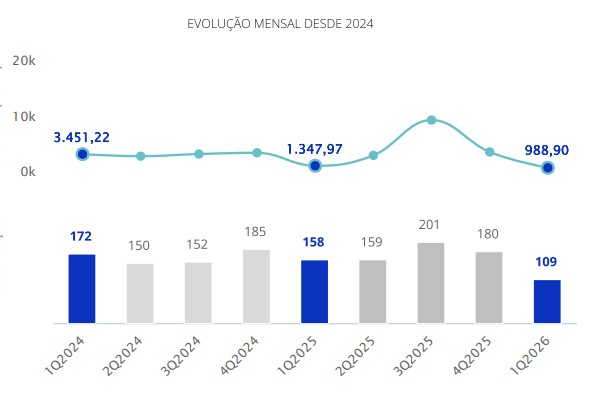
Portugal’s M&A market recorded a 31% decline in the number of transactions involving domestic companies, to 109 deals. Total deal value reached €989 million, representing a 26.6% decrease, according to TTR Data. However, it should be noted that fewer than one third (26%) of these transactions disclosed their value.
Leading the market was unicorn Sword Health, which acquired its German rival Kaia Health for $285 million (around €237 million). Analysts are still expected to select the “deal of the quarter”, in an assessment that also includes asset acquisitions, private equity investments and venture capital funding rounds.
Despite the adverse international context — with the war in the Middle East pushing up costs, particularly fuel — Portuguese companies remained active in buying and selling across several sectors. At the start of the year, the Salvador Caetano group entered the Irish market through the acquisition of automotive group Cedar, which sells around 28,000 vehicles, employs more than 600 people and generates close to €1 billion in turnover.
As part of its international expansion, this time into the United States, engineering consultancy Quadrante acquired Right Analytics, a Los Angeles-based company specialising in electrical transmission systems, whose clients include Google and global data centre operators.
In real estate, notable transactions included the sale of the Penha Longa resort in Sintra to L Catterton (backed by luxury group LVMH), as well as Sonae’s disposal of its stake in Brazil’s Parque Dom Pedro Shopping centre for €95 million.
There were also significant developments in the food industry, with Cerealis integrating the pasta operations of Spain’s Cerealto. In the shipbuilding sector, businessman Mário Ferreira strengthened his investments by acquiring the Navalria shipyards in Aveiro from Martifer for €3.7 million.
In healthcare, CUF completed the acquisition of a 75% stake in Algarve-based group HPA, following approval by the Competition Authority. Towards the end of the quarter, audit firm Baker Tilly announced the purchase of audit company Anjos & Associados, based in Porto.
Among major groups, Semapa stood out with the completion of the sale of Secil to Spain’s Molins, a transaction that will allow the Queiroz Pereira family holding company to receive more than €1 billion and generate an estimated capital gain of €400 million.
Meanwhile, Jerónimo Martins opted to redirect investment. The company announced the closure of the Hussel retail chain but confirmed interest in new assets in Poland. According to group officials, investors are “hyper-reactive” to short-term news, reflecting heightened global volatility and its immediate effects.
In 2025, the macroeconomic and geopolitical environment had already delayed transactions, pushing the market to a three-year low. During that period, 114 deals were recorded — the lowest figure since early 2022 — representing a 32% drop compared with the same period in 2024.
The main transaction in early 2025 was the acquisition of Claranet Portugal by Nos for €152 million. Despite the dynamism of the technology sector, real estate remained the most active sector, followed by travel, accommodation and leisure, and then internet and technology services. With the growing weight of Sword Health’s business, the coming months may point to a stronger role for digital healthcare.