Agreement with India opens up a market of “enormous size and potential” for Portuguese companies
Companies in the metal, automotive and wine sectors see potential for growth, while the textile industry warns that the country will be "more competitive than China is at the moment".
In a world where international trade faces increasing barriers, the agreement between the European Union (EU) and India has been received with great enthusiasm by Portuguese business representatives, who highlight the opportunities for diversification to enter a market with “enormous size and potential”, with 1.5 billion people. Industries such as metallurgy and metalworking, automotive and wine see potential for growth, but warn that the impact will not be visible in the near future. The textile industry, on the other hand, speaks of a competitor worse than China, which could steal market share from Portuguese companies.
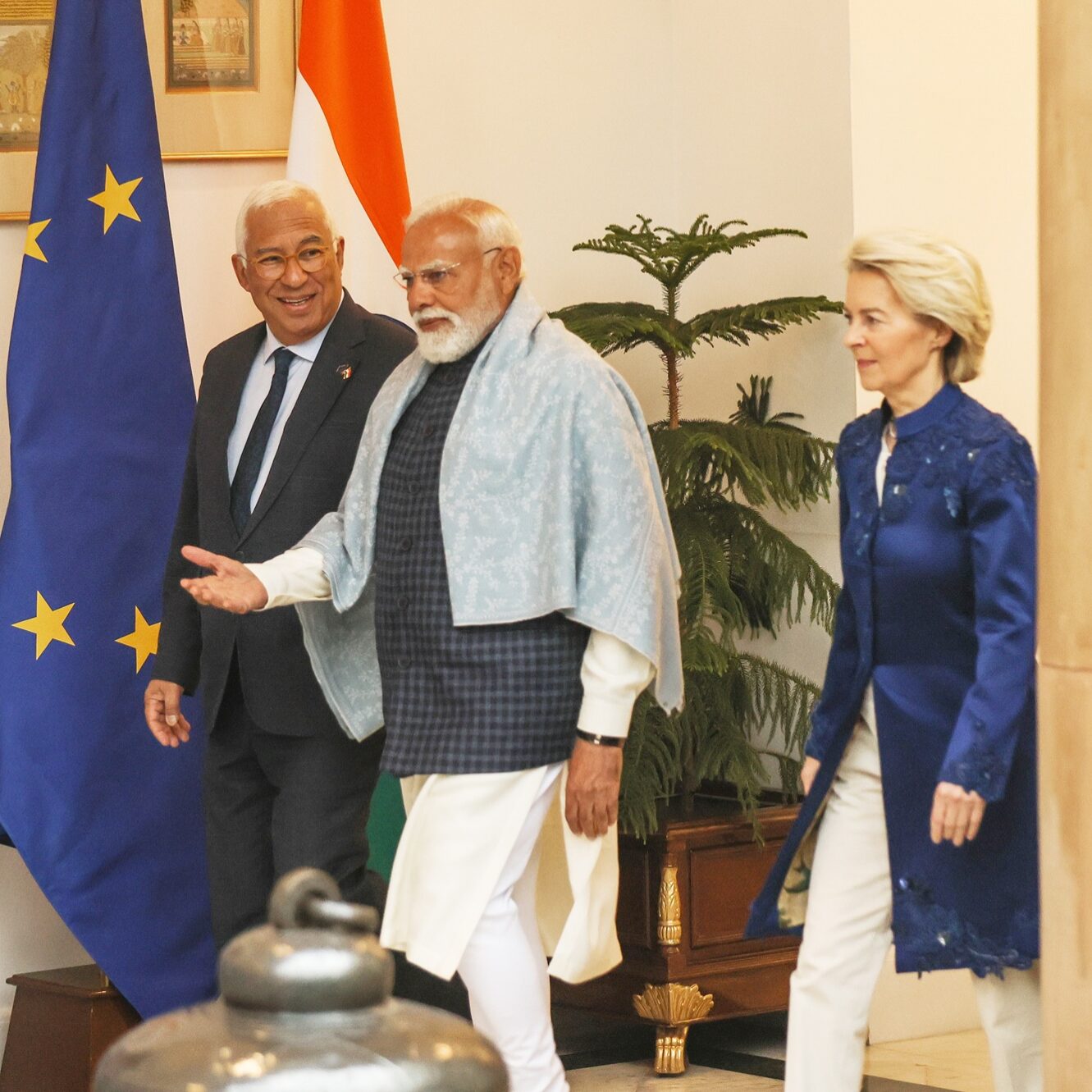
A week after the United States once again threatened European countries with additional tariffs, this time linked to Greenland, the EU signed the “mother of all trade agreements” with India. The pact marks yet another effort by the EU to open up opportunities in other regions and create “a free trade area of two billion people”, as highlighted by European Commission President Ursula von der Leyen.
“By reducing barriers to entry and increasing the competitiveness of domestic products in a large market with high growth potential, this agreement naturally presents an opportunity for new Portuguese companies to enter this market”, says the president of the Portuguese Business Association (AEP). In addition, Luís Miguel Ribeiro adds, “this agreement could enable Portuguese companies that already export to India to strengthen and consolidate their position in this market”.
According to data from the National Statistics Institute (INE), in 2024, India was the 40th largest destination for Portuguese exports of goods, with a share of 0.2%, and the 16th main country of origin for imports, with a share of 1%. “The trade balance of goods between the two countries remains unfavourable for Portugal, with a deficit of €889 million in 2024, which shows significant potential for growth in Portuguese exports to this market”, notes Luís Miguel Ribeiro.
For the leader of the AEP, “this is a particularly relevant development for Portugal as an economy open to the outside world which, in a less favourable global international context, has seen its market share reduced”. “The uncertainty associated with the protectionist trade policy pursued by the United States of America, the main non-EU destination for Portuguese exports, has weighed heavily on foreign trade and on the investment decisions of national companies, reinforcing the strategic need for market diversification.”
“What stands out, first and foremost, is the size of the Indian market and the opportunities it represents. We are talking about the most populous country in the world, with around 1.5 billion people, which, more than just consumer goods, has needs for know-how and technology that can be exploited by national companies”, points out the president of the Porto Commercial Association. In Nuno Botelho’s view, “this is a great opportunity for our economy, benefiting from specialised knowledge in areas such as renewable energy, water and waste management, and information technology itself”, describing the agreement as “very promising for the European economy and for the Portuguese economy in particular”.
Nuno Botelho also notes that “this agreement offers Portuguese companies the opportunity to actively participate in India’s ongoing structural modernisation efforts, establishing Portugal as a leading logistics and technology hub within the context of this agreement”.
“On the other hand, it is an opportunity for Portugal to strengthen its presence in a market of enormous size and potential such as India, but which, at this point, is not even among the top 40 export destinations for Portuguese companies. The advantages of this agreement, in the Portuguese case, far outweigh the risks that may result for our economy”, he anticipates.
The president of the Portuguese Industrial Association (AIP), José Eduardo Carvalho, emphasises that “this treaty creates one of the largest free trade areas in the world, covering around two billion people and approximately 25% of global GDP”. “Portugal could benefit from the drastic reduction in tariffs in sectors where it has a strong export tradition and recognised quality”, he points out.
Among the sectors that will benefit are wine, with a reduction in tariffs from 150% to 30%, and olive oil, which will go from 45% to 0%. “Portuguese mould and precision engineering companies can find a vast market to supply components and technology to the Indian automotive and aerospace industries”, he explains, noting that “Portugal is a benchmark in clean energy” and that “the agreement facilitates the export of services and technology in wind and solar energy, as well as opening up opportunities for Portuguese FinTechs in a highly digitised Indian market”.
In the automotive and components sector, he points out, there is also a reduction in tariffs from 110% to 10%, “benefiting the automotive value chain in Portugal”. In the area of pharmaceutical innovation, he indicates “enhanced intellectual property protection for innovative medicines”.
“For the automotive industry, this could be an important development at this stage in our lives”, says José Couto, president of the Association of Manufacturers for the Automotive Industry (AFIA), noting that rates on vehicles are expected to be gradually reduced from the current 110% to as low as 10%, while rates on parts will be completely abolished within five to ten years.
He points out that “India is the fourth largest car producer in the world”. “It has a powerful market that is showing growth and is the most populous country in the world”, he says, recognising “the possibility for the European automotive industry to penetrate the Indian market”, while “for components, there is the possibility for those who produce to have European components”. “It’s a window that is opening, an opportunity.”
“In the coming years, we can take advantage and enter the Indian market. We will fight for the market and for our products to be more competitive”, he adds. For the national component industry, the opportunity arises through customers in the automotive sector. “We will probably have more space to sell to construction companies that are currently in India”, explains José Couto.
However, the AFIA leader warns that the impact “will not be visible in the next two or three years. It is something that needs to be done calmly”. Even so, he admits that this is “a great opportunity and could have a positive effect at a time when international trade is changing”.
“The negotiated conditions are, in fact, advantageous for both parties. They are interesting. It is a huge, very interesting market”, he summarises.
“It is a difficult market”
Rafael Campos Pereira, executive vice-president of the Association of Metallurgical, Metalworking and Related Industries of Portugal (AIMMAP), admits to a growing interest in what “is a very interesting market, but with some difficulties that can be mitigated with this agreement”. The representative of Portugal’s export champion, which is pointing to a new record in 2025, stresses that “companies already know the market, not least because they are customers” in the purchase of raw materials, but that this “is a difficult market”.
“If, eventually, the agreement involves the non-application of tariffs on raw materials, it could be interesting”, he says.
The wine sector also views the agreement with optimism, although it admits that the impact on Portuguese companies will be limited, noting that the sector sold only €300,000 worth of wine to India in 2024, out of a total of €964 million in exports. “80% of the population is Hindu and does not consume wine, it is estimated that there are 10 million consumers” in the country, he explains, adding that India “will never be a big market for Portuguese wines”.
“I don’t believe it will have a major impact”, he predicts, despite praising European efforts to break down barriers and open up new markets.
Altino Álvares, executive president of the Portugal India Business Hub (PIBHub), points out that “many companies that did not look at India as an alternative can now do so”. “The important thing is to prepare ourselves, because the agreement will still take time to be implemented”, he explains, noting that for those who are willing to take a risk, now is the time to “put resources into exploring this market”.
In terms of opportunities for national companies, he points out that “there are many services to improve the quality of Indian products, to obtain European and international certifications”. “I think we have companies in Portugal that are very well positioned to do this.” And he gives some examples. “In the drone sector, we are doing very well and we can also form partnerships or even explore the Indian market”, he explains, adding that “in the IT sector, it will be more the other way around — that is, receiving from India to here in Portugal”.
He considers agriculture to be a sensitive area. “Even the agreement is sensitive because there is protection on both sides, but that does not mean that there cannot be specific agreements in certain areas that we can take advantage of.”
But, as with any agreement, there are two sides to the coin: “There are opportunities for Portuguese companies to go to India, as well as to receive goods in Portugal and distribute them from Portugal.”
Textiles and footwear suffer from Indian competition
The president of AIP identifies textiles, clothing and footwear as “sectors that may be adversely affected, since India is one of the world’s largest producers with much lower labour costs”. “In the generic pharmaceutical sector, due to increased competition from Indian generics (’the world’s pharmacy‘), the margins of Portuguese generic producers may come under pressure”.
Indian Prime Minister Narendra Modi addressed “associates in each sector, such as textiles, precious stones and jewellery, leather and footwear” directly, noting that “this agreement will be very beneficial for these sectors”.
In an initial reaction to the pact, Ricardo Silva, president of the Portuguese Textile and Clothing Association (ATP), said he was “very concerned”, acknowledging that this opening up could steal market share from Portuguese companies and create “disruption” in the short term. “India is a powerful textile manufacturer. It is a market that competes on price. I have serious concerns that [the agreement] could have a negative impact on the sector,” he admits, highlighting Indian competition in three areas: knitwear, yarns and fabrics.
“It will be more competitive than China is at the moment. Production costs in China are low, but we compete on quality. India still works in lower-cost production markets. There will be an appetite by European companies to try this market”, explains the textile representative.