Finance minister praises EU consensus on budgetary rules
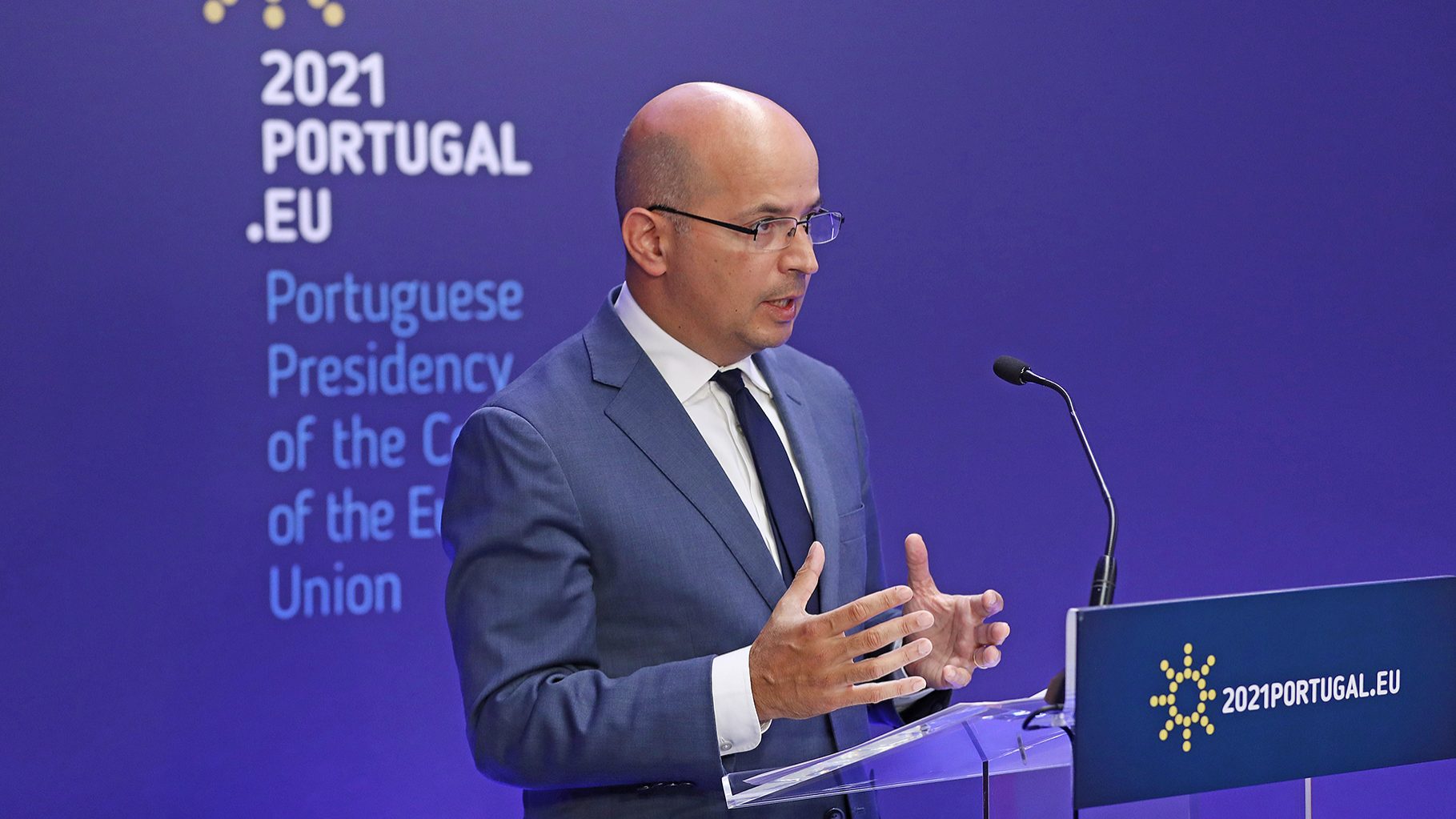
Finance minister João Leão announced that there was a "consensus" among the 27 on reassessing the reactivation of the budgetary discipline rules in 2023.
Portugal’s finance minister said on Tuesday there was a “consensus” among the 27 on reassessing, in May, the reactivation of the budgetary discipline rules in 2023 and said Portugal considered its suspension for another year would be “prudent”.
“It is important in this context to keep budgetary policy agile and flexible, and therefore the note that was left is that, as the Portuguese government wanted, in May the question of whether or not to keep the escape clause that keeps the rules suspended for another year will be back on the table,” he said, after a meeting of European Union finance ministers (Ecofin Council) in Brussels.
Recalling that “the budgetary rules have been suspended for three years now, between 2020 and 2022,” and “they were supposed to be back in force in 2023,” Leão said that “there is a consensus that we should ponder to understand whether or not it is worth keeping the rules suspended for another year, in May.”
The minister said that there was “consensus that nobody was opposed to putting the issue back on the table in May and considering keeping the budgetary rules suspended for another year.”
“Several countries were in favour. Many said there was still a great deal of uncertainty and that we needed to wait for the spring package [of the European semester of economic policy coordination] and the assessment of the macroeconomic situation to understand” whether or not it was justified to keep the Stability and Growth Pact rules suspended until 2024.
Leão said it was prudent to make “this assessment, because the effects of the crisis are very uncertain”, and that Portugal’s starting position was to agree with maintaining the suspension of the rules for another year.
“Portugal pointed out that, as far as we are concerned, we think it would be prudent to return to the end of the suspension of the rules because we are in a context of great uncertainty and the European economy is supposed to have the capacity to react to this crisis and not jeopardise the economic recovery because of a decision to resume the rules too soon,” he said.
“So Portugal remains with a favourable position. We think that at this stage, in which not only are we still recovering from the pandemic crisis, [as] we have the impact of the crisis in Ukraine, at the same time we have a situation from the point of view of the policy of the European Central Bank [ECB] quite demanding, because, with such high inflation, the ECB may have less margin to help the economy at this stage. It is, therefore, one more reason for there to be margin for countries to have the capacity to respond to the effects of the crisis,” he said.
Asked whether the extension of the escape clause for another year might not meet with resistance from “northern hawks” – member states with more rigid and conservative positions in terms of economic and fiscal policies – João Leão said that “at this stage, there is an openness on everyone’s part for it to be put back on the table, and no one has opposed it”, but admitted that “in May this discussion will be more difficult or more demanding”.
In early March, at the presentation of the budgetary policy guidelines for next year, the European Commission admitted that the military invasion of Ukraine by Russia would have economic consequences in Europe that are difficult to quantify at this stage and could call into question the announced return to budgetary discipline rules in 2023.
After the EU executive recently ruled out the possibility of extending the temporary suspension of the Stability and Growth Pact (SGP) rules beyond 2022, which was activated two years ago because of Covid-19. On 2 March, it admitted for the first time that “because of the current uncertainty” caused by the war in Ukraine, it would need to “reassess the expected deactivation of the escape clause” next year.
Brussels acknowledged that the war and possible Russian retaliation to the sanctions imposed by the EU and their rebound effect would have “a negative impact on growth, with repercussions on financial markets, further pressure on energy prices, more persistent supply chain bottlenecks and confidence effects”.
The budgetary discipline rules were relaxed precisely two years ago, in March 2020, to allow member states to react quickly and adopt emergency measures to mitigate the unprecedented economic and social impact of the Covid-19 crisis. Its deactivation was scheduled for 2023 because of the gradual economic recovery, now again jeopardised by the war launched by Russia.